






Tadweld UK Manufacturing Index 2026
Ranking Britain’s manufacturing hotspots by growth, workforce, investment and long-term Success
Manufacturing remains one of the UK’s most important industries, but succeeding in 2026 requires far more than simply producing a quality product.
Rising operating costs, skills shortages, supply chain pressures and increased taxation mean manufacturers face a growing number of challenges when it comes to investing, expanding and creating jobs.
To better understand where manufacturers are best positioned to thrive, we analysed business growth, manufacturer survival rates, workforce availability, industrial investment, transport connectivity, industrial property affordability and local support schemes across major UK manufacturing hubs.
The result is our inaugural Manufacturing Index 2026 – on which we rank the UK’s strongest locations for manufacturing growth and long-term success.
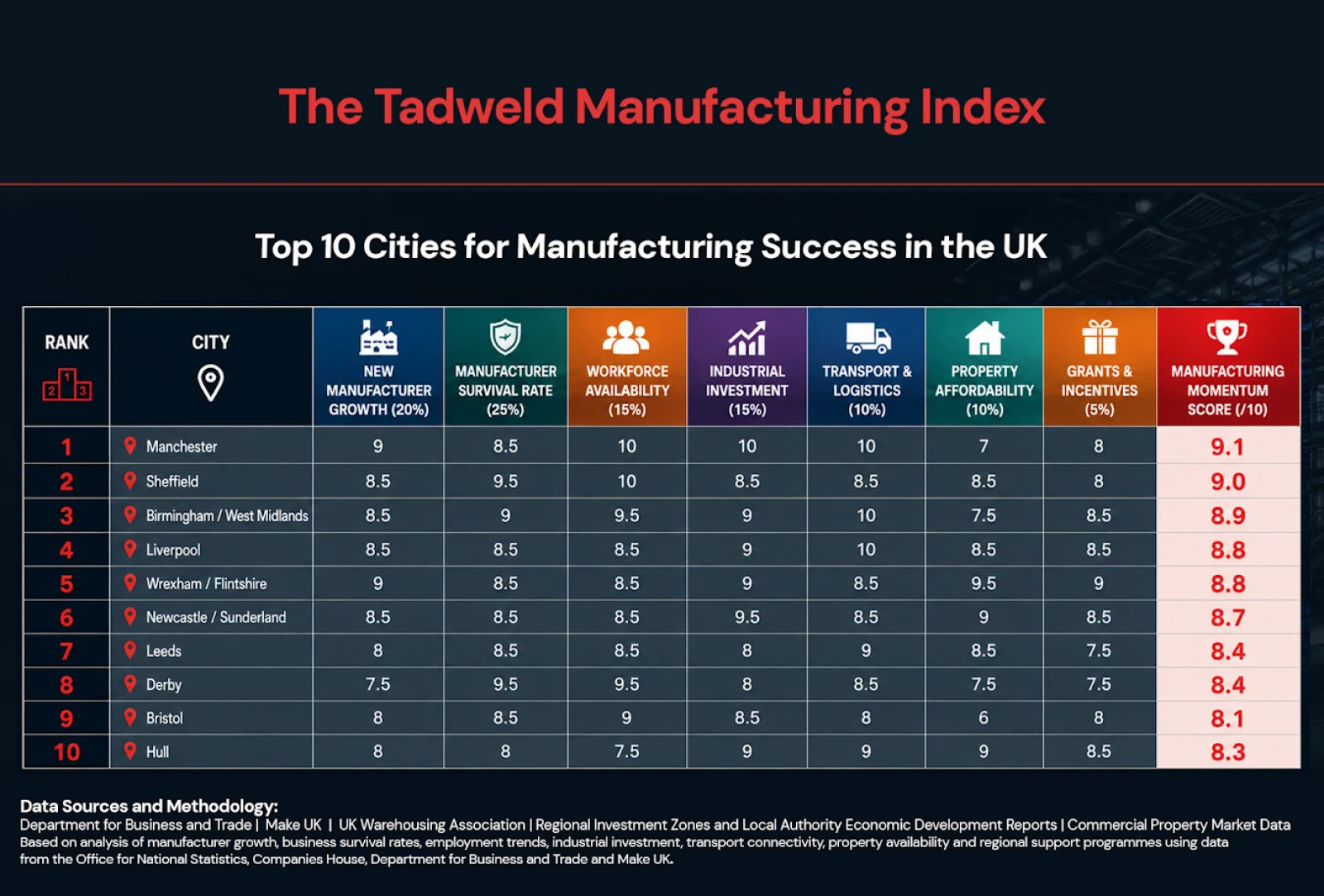
Our analysis shows that Manchester is the UK’s leading manufacturing city for 2026, achieving the highest overall manufacturing success score of each city included in our study.
Manchester performed strongly across almost every category measured, benefiting from significant industrial investment, one of the UK’s largest engineering and technical talent pools, excellent motorway and freight connections, growing advanced manufacturing clusters and strong rates of business growth.
The city’s combination of infrastructure, skills and investment has helped create an environment where manufacturers are not only launching successfully, but continuing to grow over the long term.
How the four compare
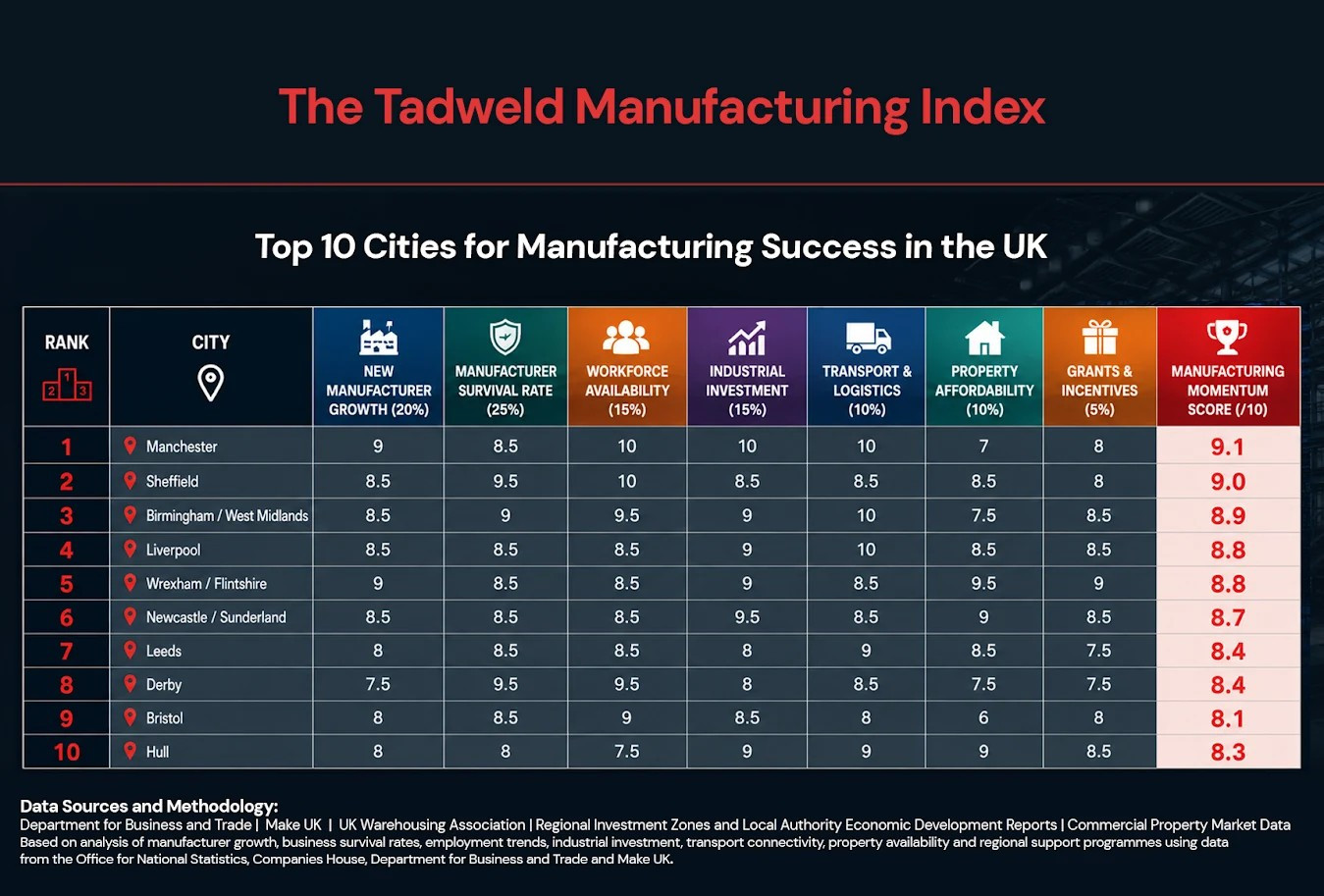
While Manchester secured first place overall, the competition between the UK’s leading manufacturing locations remains incredibly close.
Manchester (9.1)
Manchester’s position is driven by exceptional levels of investment, workforce availability, transport connectivity and manufacturing business growth. The city continues to attract advanced manufacturing businesses while benefiting from strong logistics links across the UK and internationally.
Sheffield (9.0)
As a Yorkshire-based manufacturer ourselves, it’s no surprise to see Sheffield rank among the UK’s best-performing locations. Sheffield remains one of Britain’s strongest centres for steelwork, fabrication and advanced manufacturing, supported by a highly skilled workforce and excellent long-term manufacturer retention.
Birmingham & West Midlands (8.9)
The West Midlands continues to be one of the UK’s most important industrial regions. Its central location, extensive supply chains and strong manufacturing output make it one of the most attractive locations for businesses looking to serve customers nationwide.
Liverpool (8.8)
Liverpool’s growing manufacturing sector benefits from world-class port infrastructure, strong logistics connectivity and increasing levels of investment. These advantages continue to make the city an attractive destination for export-focused manufacturers.
Our findings come at a time when many manufacturers are facing significant cost pressures.
Businesses across the sector continue to absorb increases in wages, energy costs, training costs, business rates and taxation while simultaneously being expected to invest in technology, automation and workforce development.
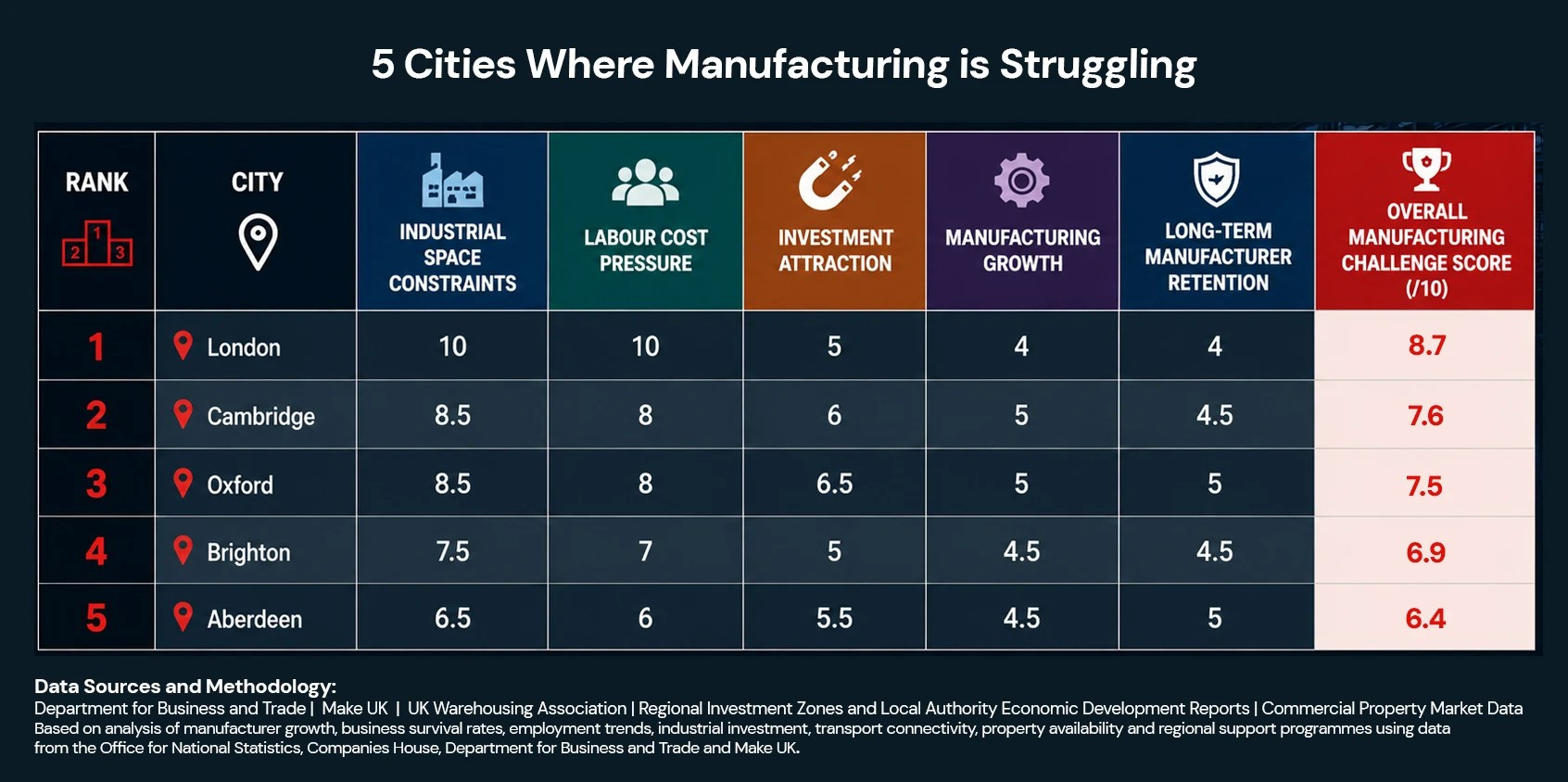
As part of our research, we also identified the locations where manufacturers face the greatest barriers to growth.
Why are some regions struggling more than others?
London continues to face challenges due to exceptionally high industrial property costs, labour costs and operational overheads.
Cambridge and Oxford remain world-leading innovation centres, but limited industrial space and high operating costs make large-scale manufacturing expansion more difficult.
Brighton has increasingly shifted towards service-based industries, reducing the availability of industrial infrastructure compared with traditional manufacturing hubs.
Aberdeen continues to navigate economic change linked to the energy transition, creating uncertainty for some manufacturing businesses and investors.
Methodology
Our study analysed major UK manufacturing locations using seven key indicators:
- Manufacturer survival rates (25%)
- New manufacturing business growth (20%)
- Workforce availability (15%)
- Industrial investment (15%)
- Transport and logistics connectivity (10%)
- Industrial property affordability and availability (10%)
- Access to grants and business support programmes (5%)
Data was compiled using information from the Office for National Statistics (ONS), Companies House, the Department for Business and Trade, Make UK, regional investment bodies, local authority economic reports and commercial property market data. The study focused on both recent manufacturing growth and long-term business resilience to identify the locations best positioned for manufacturing success in 2026 and beyond.
At Tadweld, we believe the future of UK manufacturing remains incredibly strong. While challenges undoubtedly exist, our research shows that cities across the country continue to provide the skills, infrastructure and investment needed for manufacturers to succeed for many years to come.